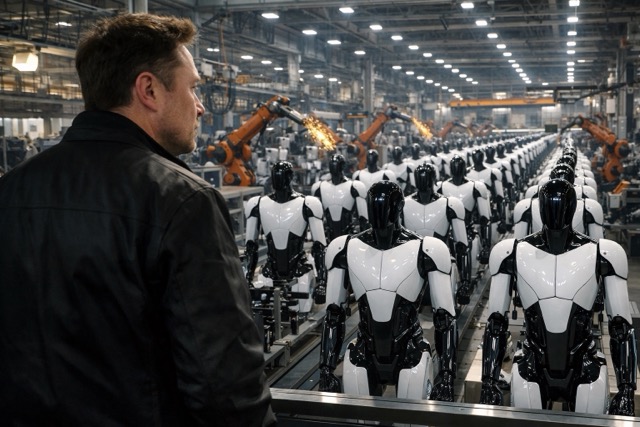
As Tesla's automotive production stabilizes and scales, the company's most audacious moonshot—the Optimus humanoid robot—is inching from lab to reality. Now, a significant clue suggests the path to mass production may run directly through Tesla's most productive and efficient factory. In a recent statement, a senior Tesla executive in China strongly hinted that Giga Shanghai, the company's export powerhouse, is being primed for a central role in manufacturing the Optimus bot, signaling a strategic fusion of Tesla's manufacturing prowess with its AI and robotics ambitions.
Shanghai's Proven Prowess Positions It for a New Challenge
Giga Shanghai is not just another Tesla factory; it is the company's largest and most efficient vehicle production center, consistently setting output records and serving as the blueprint for manufacturing innovation. The facility's mastery of speed, cost control, and supply chain integration makes it a logical candidate for Tesla's next manufacturing frontier. Deploying Optimus production in Shanghai leverages an existing ecosystem of local battery and component suppliers, a highly skilled engineering workforce, and a government that has historically supported Tesla's rapid expansion. This move would follow Tesla's established playbook: perfect a complex manufacturing process at a flagship site before replicating it globally.
From "Bots Build Bots" Vision to Global Manufacturing Reality
Elon Musk's vision for Optimus has always been twofold: creating a general-purpose humanoid robot and using those robots to automate manufacturing. Assigning a major production role to Giga Shanghai accelerates both goals. The factory can serve as the primary proving ground where early Optimus units are tasked with building their successors, turning the "bots build bots" concept into a tangible feedback loop. Furthermore, establishing high-volume production in China, a global manufacturing hub, positions Tesla to efficiently supply Optimus units to the vast Asian industrial market, where demand for automation is soaring. This gives Tesla a potential first-mover advantage in a region critical to the future of robotics.
The implications of this strategic hint are profound for Tesla's identity. Successfully manufacturing Optimus at scale would transform Tesla from an electric vehicle and energy company into a full-spectrum robotics and AI leader. Giga Shanghai's evolution into a multi-product hub would also diversify its economic importance, insulating it from the cyclical nature of the auto industry. However, the challenges are immense, requiring entirely new assembly lines, rigorous safety protocols for a novel product category, and navigating the complex regulatory landscape surrounding advanced robotics.
For Tesla owners and investors, this development underscores the company's long-term bet on automation as a primary growth driver. A Shanghai-based Optimus production line could lead to faster iteration and potentially lower costs, bringing the robot to market sooner. Investors should watch for significant capital expenditure allocations to Giga Shanghai for retooling and listen for more concrete timelines on Tesla's upcoming AI Day or Investor Day events. For owners, the success of Optimus is intrinsically linked to the advancement of the same real-world AI that powers Tesla's Full Self-Driving technology, meaning progress in the robot directly fuels the core software narrative that defines the company's premium valuation.