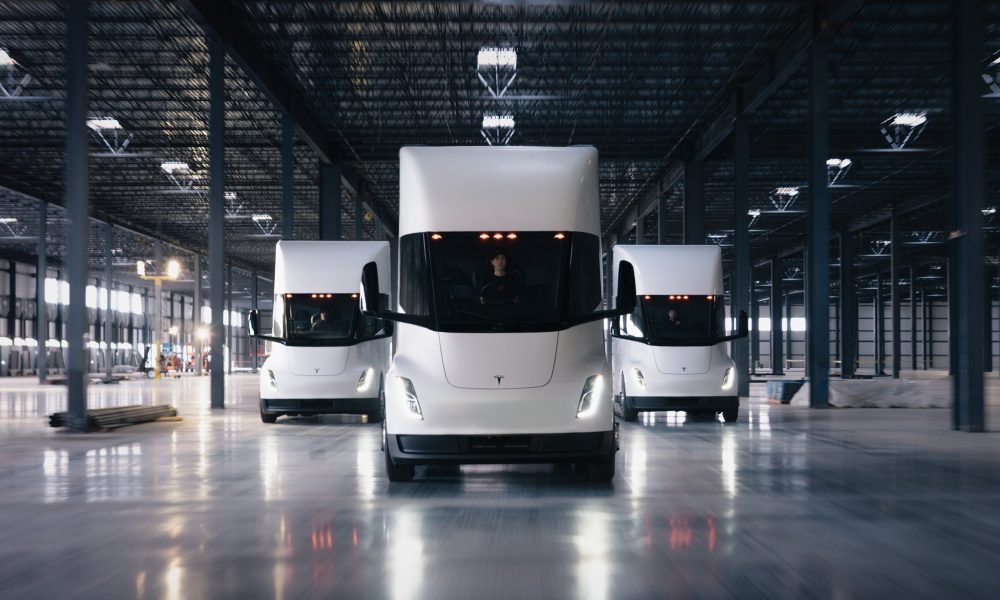
In a move that could redefine the economics of freight transport, Tesla has made a staggering claim about the durability of its long-awaited Semi. During an in-depth tour with Jay Leno, Tesla Semi program lead Dan Priestley revealed the electric Class 8 truck is engineered with a "million-mile" battery, a benchmark suggesting unprecedented longevity and total cost of ownership. This announcement, coupled with new technical disclosures, signals Tesla's confidence as it transitions the Semi from a pilot project to a high-volume manufacturing reality.
Engineering Parity and a Production Ramp
The conversation with Leno moved beyond theoretical specs to hard engineering achievements. Priestley detailed a 1,000-pound weight reduction in the 500-mile range variant, a critical milestone that now brings its payload capacity to direct parity with traditional diesel trucks. This addresses a fundamental skepticism in the trucking industry about electric vehicle (EV) payload penalties. Furthermore, Priestley confirmed the ongoing construction of a dedicated Tesla Semi factory outside Reno, Nevada, with a planned annual production capacity of 50,000 units. This scale underscores Tesla's serious commitment to capturing a significant share of the heavy-duty trucking market.
Architecture Built for the Long Haul
The disclosed "million-mile" battery isn't just a marketing term; it's a product of Tesla's evolving powertrain philosophy. The Semi utilizes three robust Permanent Magnet motors—derived from Plaid technology—arranged in a durable, efficient architecture. This setup, combined with an advanced 1,000-volt electrical system, enables remarkably fast charging. Priestley noted the Semi can recover about 70% of its range in just 30 minutes at a Tesla Megacharger, minimizing dwell time and maximizing uptime. This combination of endurance, power, and rapid refueling is designed to meet the grueling demands of regional and long-haul routes.
For Tesla investors, the Semi's progress represents a potential new pillar of growth and validation of the company's core technology. Success in the commercial sector could unlock a massive, recurring revenue stream and solidify Tesla's brand as an industrial powerhouse. The move to a dedicated factory also de-risks the production ramp, preventing it from cannibalizing resources from the company's passenger vehicle lines.
For fleet operators and future Tesla Semi owners, the implications are profoundly economic. A battery designed to last a million miles dramatically reduces the fear of costly, early battery replacements, fundamentally altering the total cost of ownership calculation. Achieving payload parity removes a major operational barrier, while the fast-charging capability enables realistic, multi-shift operations. Together, these advancements make the case for electrification not just on environmental grounds, but on hard-nosed financial ones.