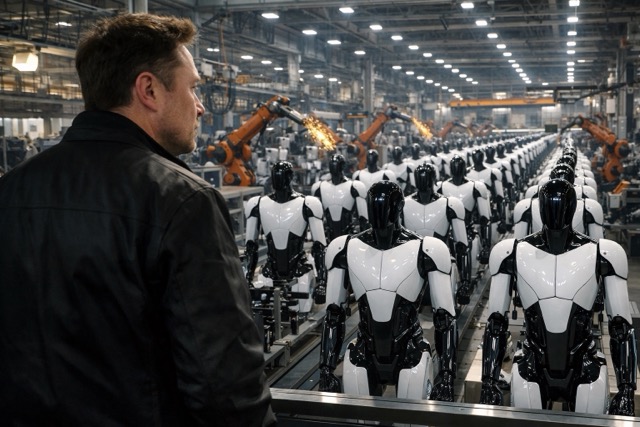
Elon Musk has never been one to think small, but his latest ambition for Tesla's humanoid robot, Optimus, redefines the scale of corporate ambition. While the automotive and energy sectors remain core, a seismic shift is occurring within Tesla's hiring patterns, revealing a clandestine sprint to transform Optimus from a lab-bound prototype into a mass-produced, world-changing product. The goal? To manufacture and deploy one million Optimus units, a move Musk believes could ultimately create a $10 trillion market value for the company. This isn't a side project; it's a full-scale offensive into the future of labor and automation.
The Hiring Blitz: From Prototype to Production Line
A deep analysis of Tesla's career page reveals a surge in job listings specifically for the Optimus program, far beyond research and development. The company is aggressively recruiting for roles in advanced actuators, sensor integration, low-level C++ software, and crucially, manufacturing engineers focused on high-volume production. This pattern indicates Tesla is applying its "machine that builds the machine" philosophy directly to robot manufacturing. They are not just building a robot; they are designing the factory that will build it at an unprecedented scale, aiming to leverage their expertise in gigacasting and streamlined supply chains to achieve unit economics previously thought impossible for humanoid robotics.
Why a Humanoid? The $10 Trillion Logic
Musk's staggering valuation isn't based on robot butlers, but on a fundamental economic premise: a general-purpose, bipedal robot can perform tasks in a world built for humans. Unlike single-function industrial arms, Optimus is designed to navigate factories, warehouses, laboratories, and eventually homes without costly environmental retrofitting. The initial application is clear: replacing repetitive, physically demanding, or hazardous tasks within Tesla's own factories. This internal proving ground would simultaneously lower vehicle production costs and refine the robots in real-time. The long-term vision, however, is an autonomous workforce that could address global labor shortages, boost productivity across all industries, and create a new platform for software and service revenue far beyond car sales.
The technical hurdles remain immense, from achieving reliable dexterity and balance to developing the artificial intelligence required for complex, unstructured tasks. Tesla is betting its vertical integration and AI advancements from its Full Self-Driving (FSD) project will provide a unique advantage. The same neural net and vision-based approach that teaches a car to navigate roads could, in theory, teach a robot to navigate a workshop. This synergy is a core part of the strategy, making Optimus less of a divergence and more of an extension of Tesla's core technological stack.
Implications for Tesla's Ecosystem and Investors
For Tesla owners and investors, the Optimus push signals a profound evolution of the company's identity. Tesla is transitioning from an electric vehicle and clean energy company to a broad-based robotics and AI enterprise. Success in this endeavor would create a revenue stream completely decoupled from the cyclical auto industry, potentially justifying a market capitalization that dwarfs its current valuation. However, it also represents a significant allocation of capital and engineering talent, introducing new execution risks. In the near term, successful deployment within Tesla's operations could dramatically improve margins, making their EVs more profitable and competitive. For the long-term investor, it represents a high-stakes bet on a future where Tesla's most valuable product may not have wheels, but two legs and a pair of hands.

