In a feat that blurs the line between classic American muscle and Silicon Valley futurism, a Sacramento-based Tesla parts specialist has achieved what many thought impossible: a fully functional 1966 Ford Mustang that not only runs on Tesla’s dual-motor drivetrain but also drives itself. The project, which took two years and roughly $40,000 to complete, is believed to be the first non-Tesla vehicle in existence to operate the automaker’s “Full Self-Driving (Supervised)” system. The result is a head-turning restomod that delivers a staggering 258 Wh/mi—efficiency figures that closely mirror a stock Model 3.
The Ultimate Restomod: Classic Looks, Tesla Brains
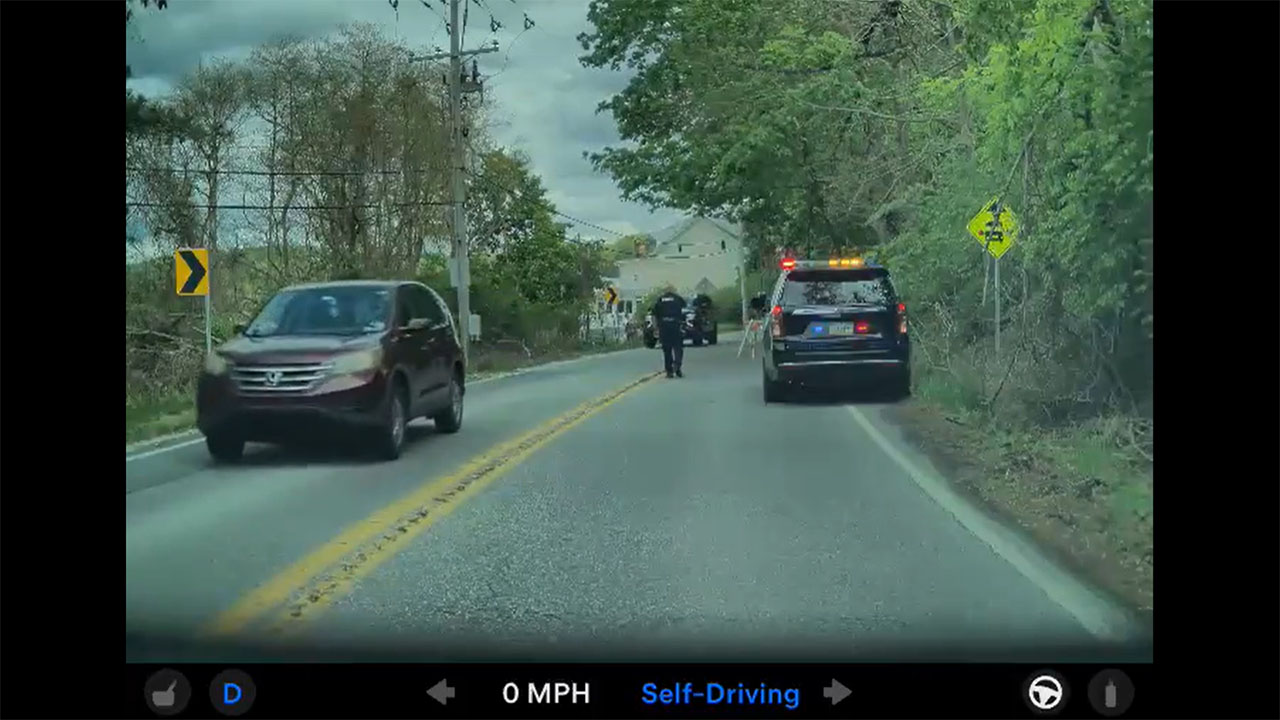
The owner, who runs a Tesla auto parts shop, didn’t just swap in a battery pack. He integrated the entire Model 3 powertrain, including the dual motors, inverter, and the critical 15-inch touchscreen that serves as the vehicle’s command center. The most audacious part, however, was the inclusion of Tesla’s FSD computer and camera suite. By carefully mounting the sensors and calibrating the system, the builder achieved a working state of “Full Self-Driving (Supervised)”—meaning the Mustang can navigate highways, change lanes, and respond to traffic signals just like a modern Tesla. This is not a simple kit car; it is a complete, drivable, and autonomous-capable electric vehicle wearing a vintage pony car shell.
Efficiency That Rivals a New Model 3
Perhaps the most surprising statistic from the build is the energy consumption. The converted Mustang achieves 258 watt-hours per mile, a figure that places it on par with a standard Model 3. This is remarkable given the Mustang’s heavier, less aerodynamic body and older chassis design. The builder achieved this efficiency through careful weight distribution and by retaining the Tesla battery management system. For EV enthusiasts, this proves that a classic car doesn’t have to be a gas-guzzling dinosaur when electrified; with the right components, it can be a remarkably efficient daily driver that also offers the convenience of supercharging compatibility.
What This Means for Tesla Owners and Investors
For current Tesla owners, this project is a proof of concept that the company’s technology—especially its FSD software—is becoming a modular platform. It suggests a future where salvage-title Teslas or crate motors could be used to electrify any vehicle, potentially increasing the resale value of wrecked Model 3s and Ys. For investors, the build demonstrates the immense value locked inside Tesla’s software ecosystem. If third-party builders can successfully integrate FSD into a 1960s Ford, it underscores that Tesla’s true competitive advantage is not just the car, but the software and neural network driving it. This could open new revenue streams for the company through licensing, while also validating the long-term viability of its autonomous driving technology in the broader automotive aftermarket.