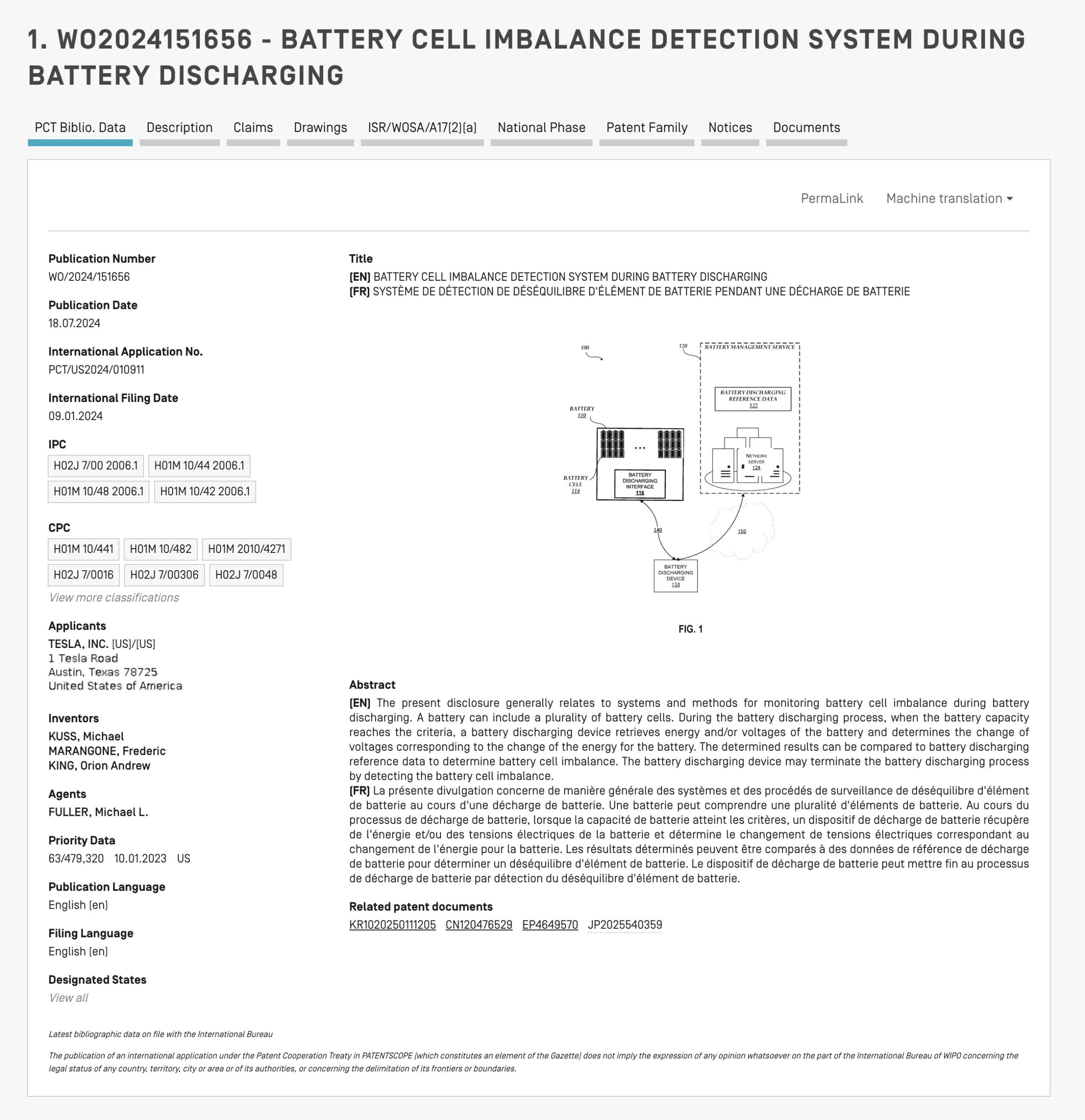
While most electric vehicle battery safety systems act like smoke detectors—reacting only after a measurable thermal event has begun—Tesla is pioneering a fundamentally different approach: preventing fires before the first abnormal chemical reaction can even occur. The company's latest breakthrough, detailed in the recently published patent WO 2024/151656 A1, reveals a proactive safety architecture rooted not in hardware sensors alone, but in advanced predictive mathematics. This shift from reactive monitoring to preemptive calculation could redefine the safety paradigm for the entire EV industry.
The Predictive Power of Differential Calculus
At the core of Tesla's innovation is the application of differential calculus to model the internal state of a battery cell in real-time. Traditional systems rely on physical sensors to measure temperature, voltage, and current. However, by the time these sensors detect an anomaly, the chain reaction leading to thermal runaway may already be irreversible. Tesla's method uses mathematical models to calculate the instantaneous rate of change of critical parameters. This allows the Battery Management System (BMS) to identify dangerous trajectories—like a sudden, microscopic spike in the rate of temperature change—long before the absolute temperature itself reaches a critical threshold. It's the difference between spotting a spark and predicting the conditions that will create one.
From Patent to Proactive Protection
The patented system creates a continuous, software-driven safety net. By solving differential equations derived from the electrochemical and thermal dynamics of the cell, the BMS can estimate internal states that are impossible to measure directly with external sensors, such as localized lithium plating or minute separator degradation. If the calculus indicates a trajectory toward a dangerous state, the system can take immediate, autonomous countermeasures. These include precisely limiting charging current, adjusting thermal management protocols, or initiating targeted cooling to a specific module. This moves safety interventions from the macro, physical world into the micro, predictive digital realm.
This advancement is a direct evolution of Tesla's deep vertical integration and its vast real-world data pool. The mathematical models are undoubtedly refined by data from its global fleet of over 5 million vehicles, learning from billions of miles of driving and charging cycles. The approach turns every Tesla into a sentinel, contributing to a continuously improving understanding of battery behavior. It also underscores a key Tesla philosophy: the most critical safety feature is often invisible software, not just robust hardware.
For Tesla owners and investors, the implications are profound. Owners benefit from an intrinsic, ever-improving layer of safety that works silently to preserve both battery health and vehicle integrity, potentially extending pack lifespan and maintaining resale value. For investors, this patent exemplifies Tesla's sustainable competitive moat in software and systems integration. As competitors chase raw battery energy density, Tesla is advancing the critical intelligence that manages that energy safely and efficiently. This focus on predictive safety not only strengthens brand trust but also positions Tesla's technology as the foundational standard for the next generation of electric vehicles, making its approach a potential licensing opportunity and a significant barrier to entry for less sophisticated rivals.