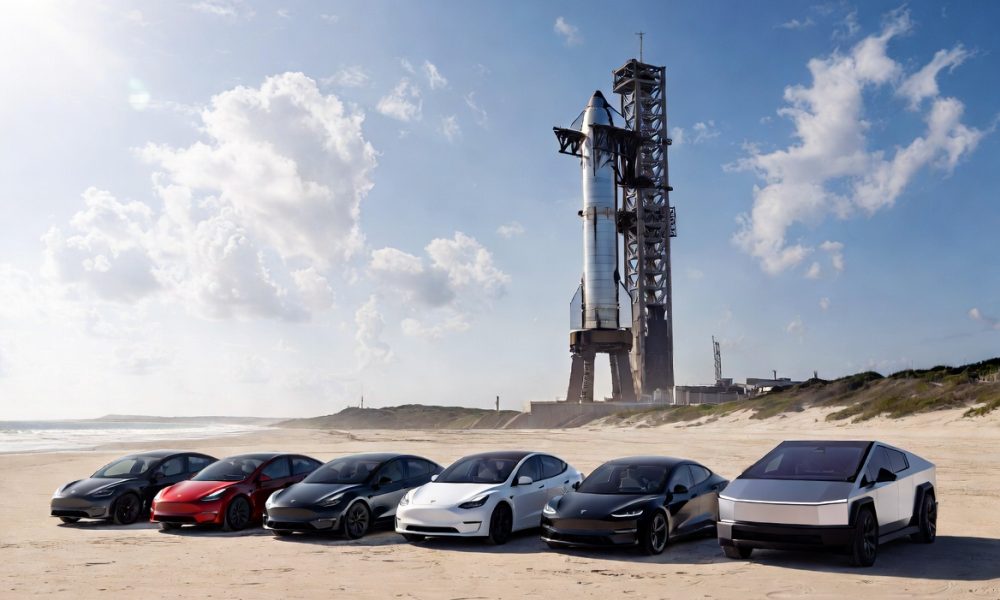
A bombshell prediction from a prominent Wall Street analyst is sending shockwaves through the financial and tech worlds, suggesting that two of Elon Musk's most iconic companies could be on a collision course for corporate unity. In a bold new research note, Wedbush Securities' Dan Ives has forecast a potential merger between Tesla and SpaceX as soon as 2027, framing it not as science fiction but as a strategic inevitability. This vision, if realized, would create a technological behemoth unlike any other, fundamentally reshaping the landscape of electric vehicles, space exploration, and artificial intelligence.
The Logic Behind a Seemingly Audacious Prediction
Ives's argument hinges on the increasingly blurred lines between the two companies' core missions and technological roadmaps. While Tesla dominates terrestrial EV and energy storage, and SpaceX leads in orbital access and satellite constellations, their convergence is accelerating. Shared AI development for autonomous vehicles and rocket guidance, the use of advanced materials, and the potential integration of SpaceX's Starlink connectivity into every Tesla vehicle are creating a deep, proprietary technology stack. Ives contends that a formal merger would unlock immense value by fully consolidating these synergistic innovations, eliminating operational redundancies, and creating a unified balance sheet to fund colossal R&D ambitions.
Musk's Grand Vision: A Unified Tech Empire
At the heart of this prediction lies Elon Musk's long-stated, overarching ambition: the multi-planetary expansion of human consciousness. In this context, Tesla and SpaceX are not separate entities but complementary pillars of a single goal. Tesla's work on sustainable energy and autonomy is seen as foundational for future Martian settlements, while SpaceX provides the transportation. A merger would structurally cement this vision, allowing capital and talent to flow seamlessly toward what Musk has called "the future I want to exist." It would transform the combined entity from a car company and a rocket company into a singular next-era technology conglomerate, positioned to tackle challenges from terrestrial transport to interplanetary logistics.
However, the path to such a historic merger is fraught with monumental complexity. Regulatory scrutiny from agencies like the SEC and FTC would be intense, given the scale and market power of a combined Tesla-SpaceX. The corporate structures are vastly different—Tesla is a publicly traded giant, while SpaceX remains privately held—posing significant challenges for shareholder approval and valuation. Furthermore, each company carries its own distinct culture, risk profile, and investor base, which would need to be carefully integrated to avoid disruptive friction.
Implications for Tesla Stakeholders
For Tesla owners and investors, the potential ramifications are profound. A merger could accelerate the infusion of aerospace-grade engineering and connectivity into Tesla vehicles, potentially justifying premium valuations. Conversely, it introduces new layers of risk, tying Tesla's fortunes directly to the capital-intensive and high-stakes space industry. Investors must weigh the promise of unprecedented innovation against potential dilution and increased volatility. Ultimately, Ives's prediction forces a fundamental question: is the future of Tesla not just on the road, but in the stars? How one answers that may define investment theses for the rest of the decade.