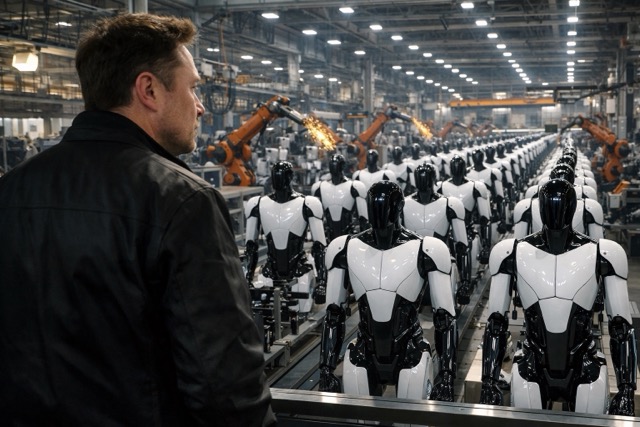
In a moment of stark candor that has sent ripples through the tech and investment communities, Elon Musk has conceded that Tesla's highly publicized Optimus humanoid robots are not yet performing any meaningful tasks within the company's own operations. This admission, made during the Tesla Q4 2025 earnings call, directly contradicts a two-year narrative of imminent, real-world deployment and forces a recalibration of expectations for one of Tesla's most ambitious—and speculative—ventures.
A Pivot from Promise to Reality
For years, Musk has been the chief evangelist for Optimus, portraying it not as a distant research project but as a product on the verge of revolutionizing labor. He previously suggested the robots were already performing simple factory jobs, a claim that bolstered Tesla's image as a leader in advanced automation. The recent statement, however, draws a clear line between demonstration videos and genuine utility. "We don't have any Optimus robots doing useful work in its factories right now," Musk stated, shifting the focus to ongoing development and the immense challenge of creating a general-purpose machine that can navigate the unstructured chaos of a real-world environment.
The Weight of Contradiction and Market Implications
This reversal is significant because the Optimus narrative has been tightly woven into Tesla's long-term investment thesis. Musk has framed it as a potential solution to labor shortages and a future revenue stream dwarfing the automotive business. The admission that no "useful work" is being done punctures the near-term hype and raises questions about the timeline to commercialization. Analysts are now scrutinizing whether this signals a fundamental technical hurdle or simply a more sober, staged approach to development. The discrepancy between past claims and current reality also touches on the perennial debate about Musk's ambitious timelines and their impact on market perception.
The context of the Q4 2025 earnings call is crucial. Tesla faces intensifying competition in the core EV market and pressure to deliver growth. In this climate, futuristic projects like Optimus and Full Self-Driving represent both tremendous upside and a risk of distraction. By tempering expectations for the robot, Musk may be attempting to refocus investor attention on the company's automotive and energy businesses, while managing the risk that repeated delays could eventually erode credibility for the entire Optimus endeavor.
For Tesla owners and investors, this development is a double-edged sword. On one hand, a more transparent and measured update on Optimus could foster realistic long-term planning, separating the core electric vehicle business's value from speculative tech. On the other, it underscores the high-risk, long-term nature of this bet. The capital and engineering resources devoted to Optimus are substantial, and its success is far from guaranteed. Investors must now weigh whether Tesla's industry-leading manufacturing and AI expertise can eventually overcome the revealed challenges, or if Optimus will remain a compelling demo that struggles to find economic purpose.