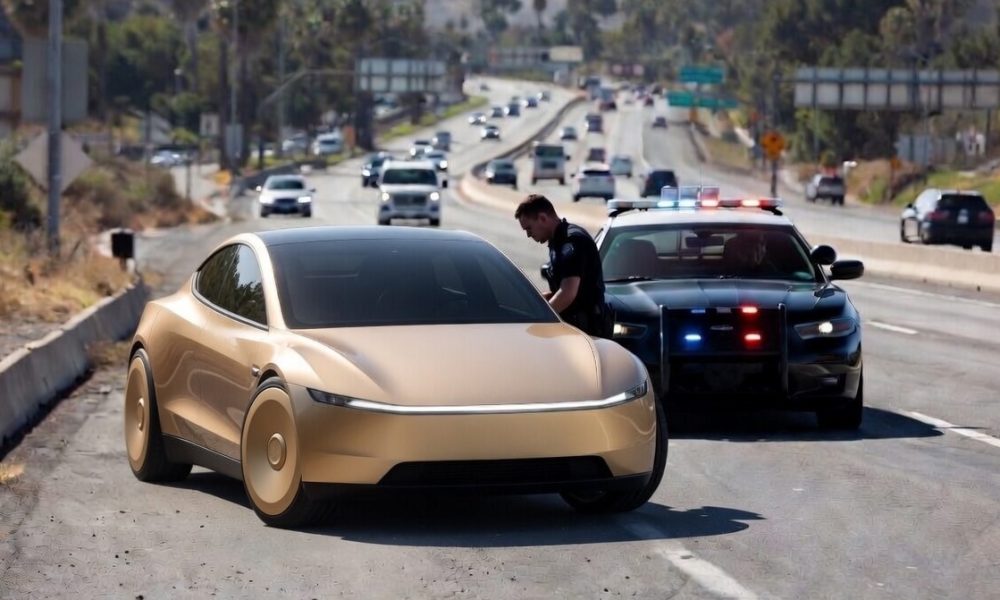
California has fired a regulatory shot across the bow of Tesla’s ambitious robotaxi ambitions. A new law now grants police officers the explicit authority to issue tickets to driverless vehicles, including those from Tesla’s upcoming Cybercab fleet, fundamentally altering the legal landscape for autonomous driving in the Golden State. The move signals that Sacramento is not waiting for the future to arrive—it is actively shaping the rules of the road for a new era of transportation.
The New Law and Its Immediate Impact on Tesla
Signed into law by Governor Gavin Newsom, the legislation closes a critical loophole that previously left law enforcement without clear recourse when a driverless car committed a traffic violation. Under the new statute, police can now cite the vehicle’s registered owner or the operating company—meaning Tesla could be held directly liable for infractions committed by its Cybercab or other autonomous taxis. This is a direct challenge to Tesla CEO Elon Musk’s vision of a massive, unsupervised robotaxi network, as it introduces a clear enforcement mechanism that could lead to fines, impoundment, or even fleet-wide restrictions if violations become systemic.
Context and Analysis: A Preemptive Strike on Robotaxi Safety
This law does not exist in a vacuum. California has long been a battleground for autonomous vehicle regulation, with companies like Waymo and Cruise already facing intense scrutiny over traffic incidents and pedestrian interactions. By granting police ticket-writing power, the state is effectively saying that the electric vehicle revolution must be paired with accountability. For Tesla, which relies on a vision-only system without lidar, the stakes are especially high. The company has yet to prove its Full Self-Driving (FSD) software can handle complex urban environments without human intervention. If a fleet of Cybercabs begins accumulating citations for running red lights or blocking intersections, the regulatory backlash could delay or even derail the entire project.
Implications for Tesla Owners and Investors
For current Tesla owners, this law signals that the regulatory path to true robotaxi ownership—where your personal vehicle earns money while you sleep—just became steeper. The state now has a direct tool to penalize autonomous operations, which could increase insurance costs and operational hurdles for those hoping to enroll their cars in a future Tesla network. For investors, this is a sobering reminder that regulatory risk is not just theoretical. The Cybercab is a cornerstone of Tesla’s long-term valuation thesis, and any limitation on its deployment in California—the largest EV market in the U.S.—could compress growth expectations. The message from Sacramento is clear: autonomous driving will be allowed, but only under a strict, enforceable framework. Tesla must now prove its technology can operate flawlessly, or face the consequences in the form of tickets, fines, and lost consumer trust.