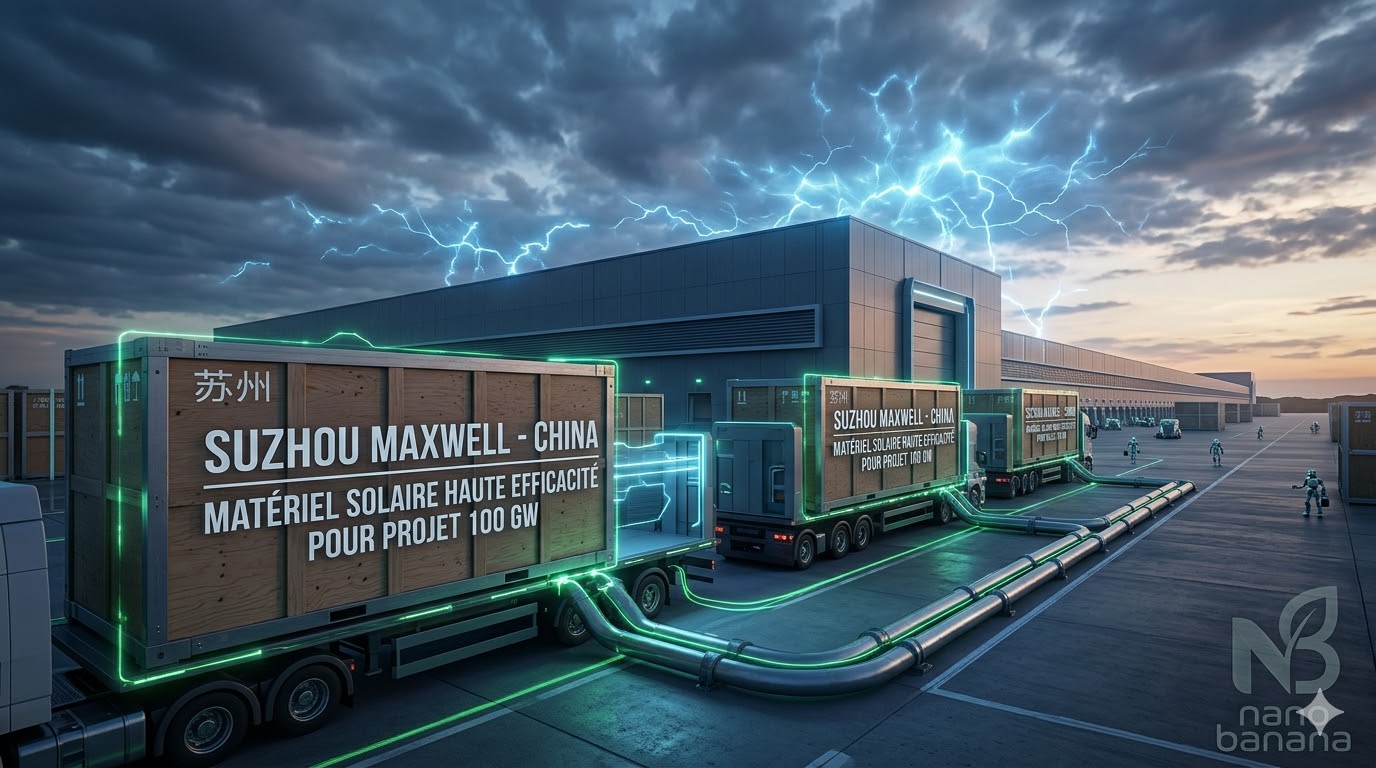
In a bold maneuver that underscores the intricate dance of global politics and technological ambition, Tesla has committed a staggering $2.9 billion to Chinese manufacturing partners. This investment, aimed at importing specialized machinery from Suzhou Maxwell Technologies into its Texas Gigafactory, appears on the surface to be a play for energy independence. However, a deeper analysis reveals this is not merely about solar panels; it is a critical, calculated gambit to solve the monumental energy demands of the next generation of artificial intelligence and, ultimately, to power the future of Full Self-Driving (FSD).
The Realpolitik of a $2.9 Billion Supply Chain
At a time of heightened trade tensions between the U.S. and China, Tesla's massive capital outlay to Chinese suppliers is a masterclass in industrial pragmatism. The company is procuring advanced, cost-effective manufacturing equipment from Suzhou Maxwell, a leader in dry electrode coating technology. This process is crucial for producing the next generation of 4680 battery cells with greater efficiency and lower cost. By bringing this machinery to Texas, Tesla seeks to vertically integrate its most critical component—the battery—while navigating geopolitical friction. This move is less about reliance and more about swiftly acquiring best-in-class technology to build a self-sustaining, American-based supply chain for both its vehicles and its growing Tesla Energy division.
Beyond Solar: Powering the AI Compute Beast
The narrative that this investment solely bolsters Tesla's solar and Powerwall offerings is only half the story. The true endgame is computational. The development of advanced artificial intelligence, particularly the neural networks training Tesla's FSD system, requires an astronomical amount of energy. Each iteration of the FSD algorithm demands processing in massive, power-hungry data centers. Tesla's bet is that by controlling its own energy destiny—from the raw battery cell production to large-scale solar generation and storage—it can create a closed-loop, sustainable power ecosystem. This energy independence is not for homes; it's to fuel the Dojo supercomputer and its successors, ensuring that the quest for autonomous driving isn't throttled by grid limitations or soaring energy costs.
Implications for Owners and the Energy Grid
For Tesla owners and investors, this strategy has multifaceted implications. Successfully scaling this technology will lower battery costs, potentially reducing vehicle prices and increasing margins. More profoundly, it directly accelerates the FSD timeline by removing a fundamental bottleneck: compute energy. For Tesla Energy customers, it promises more efficient and affordable Powerwall and Megapack storage solutions, strengthening the value proposition of a full Tesla ecosystem. On a macro scale, Tesla is positioning itself not just as an automaker, but as a foundational energy company. Its ability to generate and store its own clean power at gigafactory scale could provide a stabilizing force for local grids, while setting a new industrial standard for sustainable manufacturing.
The $2.9 billion paradox—investing in a geopolitical rival to achieve American energy sovereignty—is a defining moment for Tesla. It reveals a long-game strategy where solar, storage, and supercomputing are inextricably linked. The outcome will determine whether Tesla can secure the cheap, abundant, and clean energy required to make true artificial intelligence and full autonomy a reality.