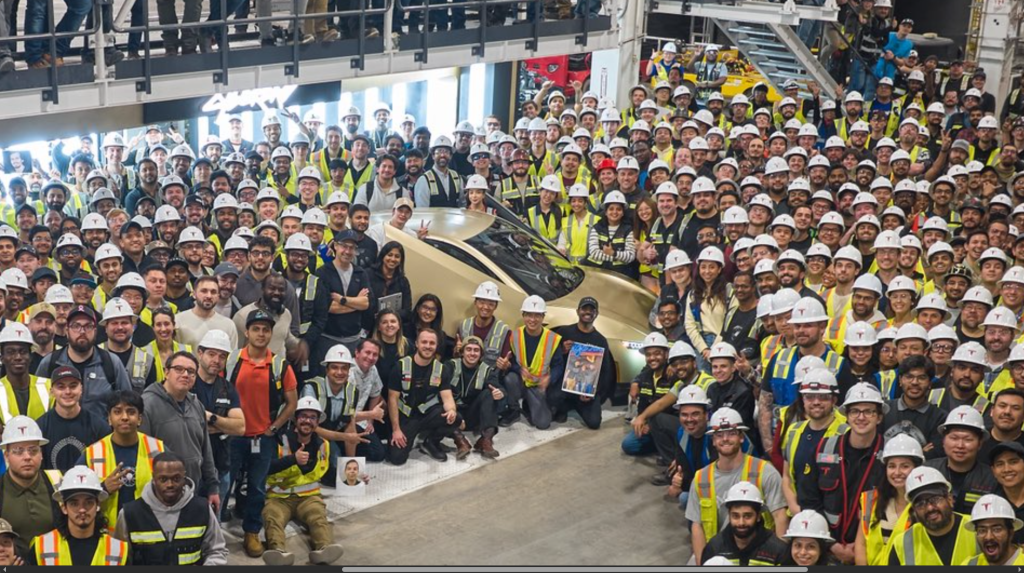
In a move that signals a decisive pivot from ambitious prototype to tangible product, Tesla has achieved a critical manufacturing milestone for its autonomous future. The company has confirmed that the first production-intent Tesla Cybercab has officially rolled off the line at its Giga Texas facility. This event, shrouded in the typical secrecy of a Tesla "unboxed" product, marks the beginning of a new chapter not just for the automaker, but for the entire mobility landscape, transforming a vision once confined to Investor Day presentations into a physical reality on the factory floor.
From "Unboxed" Concept to Concrete Reality
The Cybercab's journey to production has been accelerated by Tesla's innovative "unboxed" manufacturing strategy, a process designed to simplify assembly and radically reduce costs. Unlike traditional vehicle construction, this approach involves building large sub-assemblies in parallel before final integration, a method theoretically perfect for a purpose-built autonomous vehicle (AV) with fewer complex components. The successful build at Giga Texas validates the scalability of this experimental process for a completely new vehicle architecture. This milestone arrives roughly six weeks before Tesla’s planned dedicated Robotaxi unveiling event on August 8, 2024, setting the stage for what is expected to be a deep dive into the vehicle's design, technology, and business model.
The Core Challenge: Autonomy Itself
While manufacturing the vehicle is a monumental step, the true determinant of the Cybercab's success lies in the software that drives it. The vehicle's entire raison d'être hinges on the full maturation of Tesla's Full Self-Driving (FSD) suite to a reliable, regulator-approved Level 4 or 5 autonomy. Tesla has made significant strides with its FSD v12 updates, employing an end-to-end neural network, but the leap to a driverless, geofenced, or ubiquitous robotaxi service involves solving the monumental "last 1%" of edge cases and securing regulatory approvals across countless jurisdictions. The Cybercab's production proves Tesla can build the hardware; the next two months will be focused on convincing the world it has perfected the intelligence.
Strategic Implications for Tesla and the EV Market
The Cybercab's arrival has profound strategic implications. For Tesla, it represents a bold diversification into the mobility-as-a-service (MaaS) sector, potentially creating a high-margin revenue stream that complements vehicle sales. It also serves as the ultimate validation of its FSD investment. For the broader electric vehicle (EV) market, a functional Tesla Robotaxi network could dramatically accelerate EV adoption by providing low-cost, convenient access to electric transport, while simultaneously pressuring traditional automakers and ride-hailing giants who are developing their own AV projects. The move firmly positions Tesla not just as a car company, but as a vertically integrated technology and logistics disruptor.
For Tesla owners and investors, the production milestone is a tangible sign of execution on a long-promised vision. It de-risks, to a degree, the narrative around Tesla's future growth being solely dependent on consumer car sales cycles. Investors will now scrutinize the August 8th unveil for details on cost, scalability, and the specific rollout timeline for commercial service. Owners, particularly those with FSD packages, may see the Cybercab as the harbinger of increased software value and a potential personal opportunity to enroll their own vehicles in a future Tesla ride-hailing network. The road ahead remains complex, but the first vehicle off the line proves Tesla is accelerating into that future.