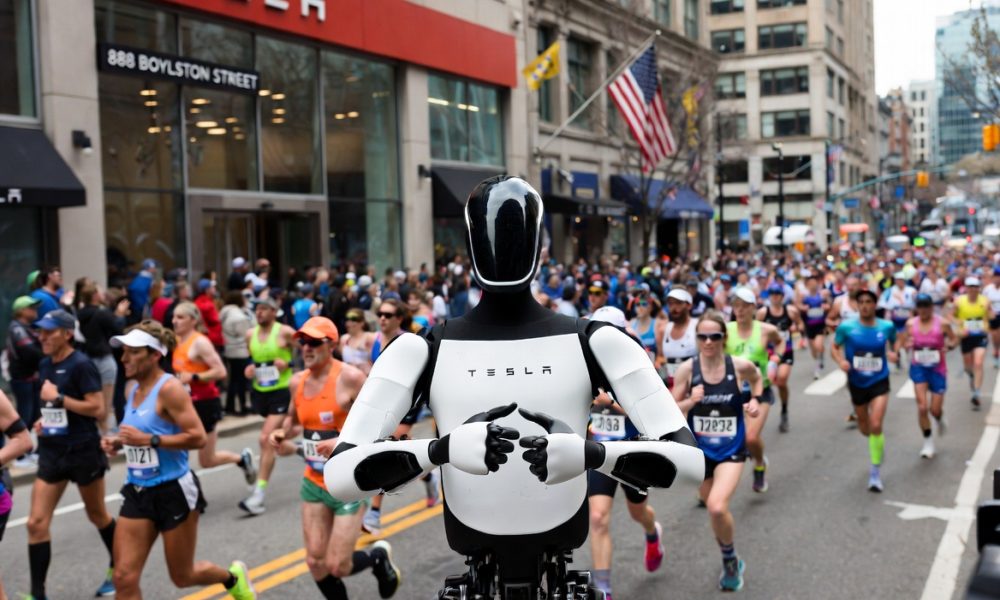
In a move that blurs the lines between high-stakes athletics and high-tech spectacle, Tesla is preparing to deploy its Optimus humanoid robot to the hallowed grounds of the Boston Marathon finish line. This unexpected appearance, confirmed via a social media post from Tesla, is not merely a publicity stunt but a bold, real-world stress test for its most ambitious robotics platform. By placing Optimus in the chaotic, unpredictable environment of a major marathon finale, Tesla aims to demonstrate a leap in robotic stability, sensory processing, and autonomous operation that could redefine its commercial timeline.
A Grueling Test of Real-World Agility
The Boston Marathon presents a uniquely challenging proving ground. Unlike the controlled confines of a lab or factory floor, the finish line area on Boylston Street is a dense throng of exhausted athletes, excited spectators, medical personnel, and media. For Optimus, navigating this dynamic terrain requires exceptional balance, advanced obstacle avoidance, and the ability to process a flood of visual and spatial data in real time. Tesla's objective is clear: to prove that its bipedal robot can operate reliably in complex human spaces. A successful demonstration would signal that Optimus is evolving from a research prototype toward a viable product capable of performing tasks in warehouses, factories, and eventually homes.
The Strategic Race Beyond Electric Vehicles
This marathon appearance is a strategic marker in Tesla's broader corporate identity. While its core EV business faces increased competition, Tesla is aggressively positioning itself as a leader in adjacent fields of autonomy and artificial intelligence. Optimus represents the physical embodiment of that AI stack. By showcasing it at a globally watched event, Tesla reinforces its narrative as a company not just building cars, but pioneering a general-purpose, automated future. The demonstration serves a dual purpose: it captures public imagination and assures investors that the company's long-term bets on robotics and AI are progressing toward tangible, revenue-generating applications.
The underlying technology powering this demo is as critical as the spectacle itself. Optimus will likely rely on a refined version of the computer vision and neural net planning that powers Tesla's Full Self-Driving (FSD) software. Translating two-dimensional camera data into a three-dimensional understanding of a crowded space and then executing precise physical movements is a monumental software challenge. Any performance—whether flawless or flawed—will provide Tesla's engineers with invaluable data to accelerate development, far beyond what can be learned in simulation.
Implications for the Tesla Ecosystem
For Tesla owners and investors, the Boston Marathon run is a high-visibility milestone with significant implications. A strong performance could bolster confidence in Tesla's technological moat and its potential to unlock a massive new market in humanoid robotics, a sector some analysts project could be worth tens of billions in the coming decades. Conversely, any public stumbles, while potentially part of the learning process, could invite skepticism about the project's feasibility and timeline. Ultimately, this live demonstration is a daring gamble that underscores CEO Elon Musk's vision of Tesla as a conglomerate of disruptive technologies, where advancements in AI for robots directly inform and improve the autonomy of its electric vehicles, creating a powerful, synergistic flywheel for innovation and growth.