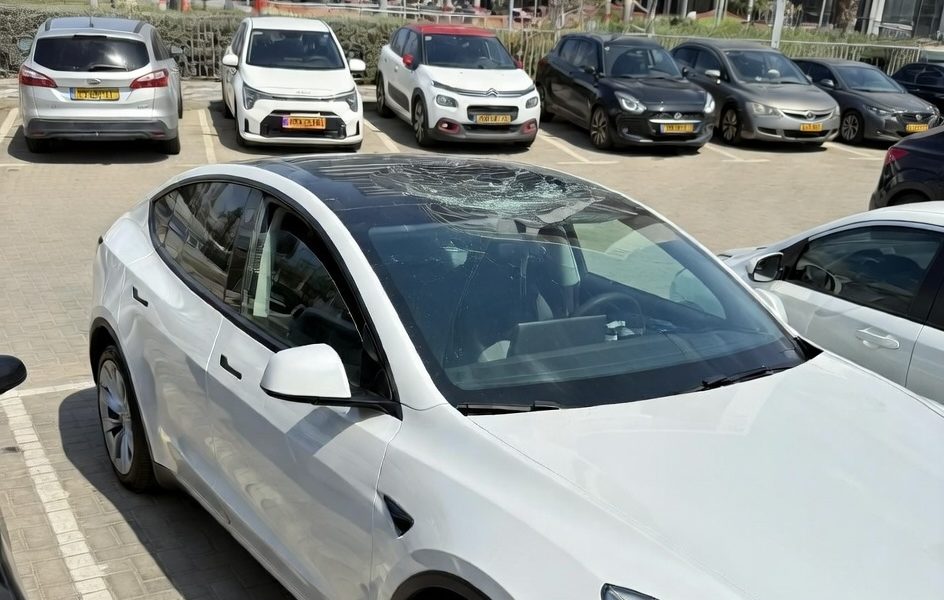
In a testament to modern automotive engineering under the most extreme conditions, a Tesla vehicle in Israel has survived a direct impact from Iranian missile debris. The incident, which occurred during the recent aerial assault, saw shrapnel strike the car's glass roof, which astonishingly held without catastrophic failure. This event transcends a mere viral story, offering a stark, real-world case study on vehicle safety and structural integrity in an unforeseen scenario.
The Incident: A Real-World Stress Test
Details emerging from the scene indicate the Tesla was parked when it was struck by falling debris from an intercepted missile. The most significant damage was concentrated on the vehicle's expansive glass roof, a signature design element of many Tesla models. Unlike conventional steel roofs, the laminated glass absorbed the high-energy impact, cracking but not shattering completely. This prevented debris from penetrating the cabin, a critical factor in occupant safety. The vehicle's body structure also appears to have remained largely intact, suggesting the underlying architecture managed the impact forces effectively.
Engineering Behind the Survival
This survival story is not accidental but rooted in stringent safety engineering. Tesla's glass roof utilizes a laminated construction, similar to a windshield, with a polyvinyl butyral (PVB) interlayer that holds the glass together upon impact. Furthermore, the vehicle's rigid passenger cell, fortified by its underbody battery pack which adds significant torsional stiffness, creates a robust safety capsule. While no car is designed for ballistic events, Tesla's focus on a low center of gravity and a high-strength architecture—primarily for crash safety—unintentionally provided a degree of resilience in this extraordinary event. The incident serves as an impromptu, and severe, validation of these passive safety features.
The context of this event is also crucial. The debris likely originated from defensive interceptions, meaning the fragments were traveling at terminal velocity rather than the hypersonic speed of a direct missile strike. This distinction is important for a realistic analysis; the vehicle withstood an impact from shrapnel, not a precision-guided munition. Nevertheless, the outcome highlights how advanced electric vehicle platforms, with their unique structural paradigms, can respond to violent impacts differently than traditional internal combustion vehicles.
Implications for Owners and the EV Industry
For Tesla owners and investors, this incident reinforces the brand's core message of safety, albeit in a manner no one would wish to replicate. It provides a dramatic, tangible data point that could resonate deeply with safety-conscious consumers. For the broader EV industry, it underscores how the fundamental architecture of a battery-electric vehicle—with its fortified floor and rigid frame—contributes to occupant protection in multifaceted ways. However, it also invites scrutiny into the long-term repair costs and protocols for such unique damage, particularly concerning specialized glass and sensor recalibration.
Ultimately, this story is a sobering reminder of technology intersecting with global conflict. While the primary takeaway is a remarkable demonstration of vehicular resilience, it also opens conversations about the role of consumer-grade technology in extraordinary circumstances. For Tesla, the narrative, while born from adversity, inadvertently strengthens its position on the cutting edge of automotive safety and durability, proving that its vehicles are built to protect in even the most unpredictable situations.