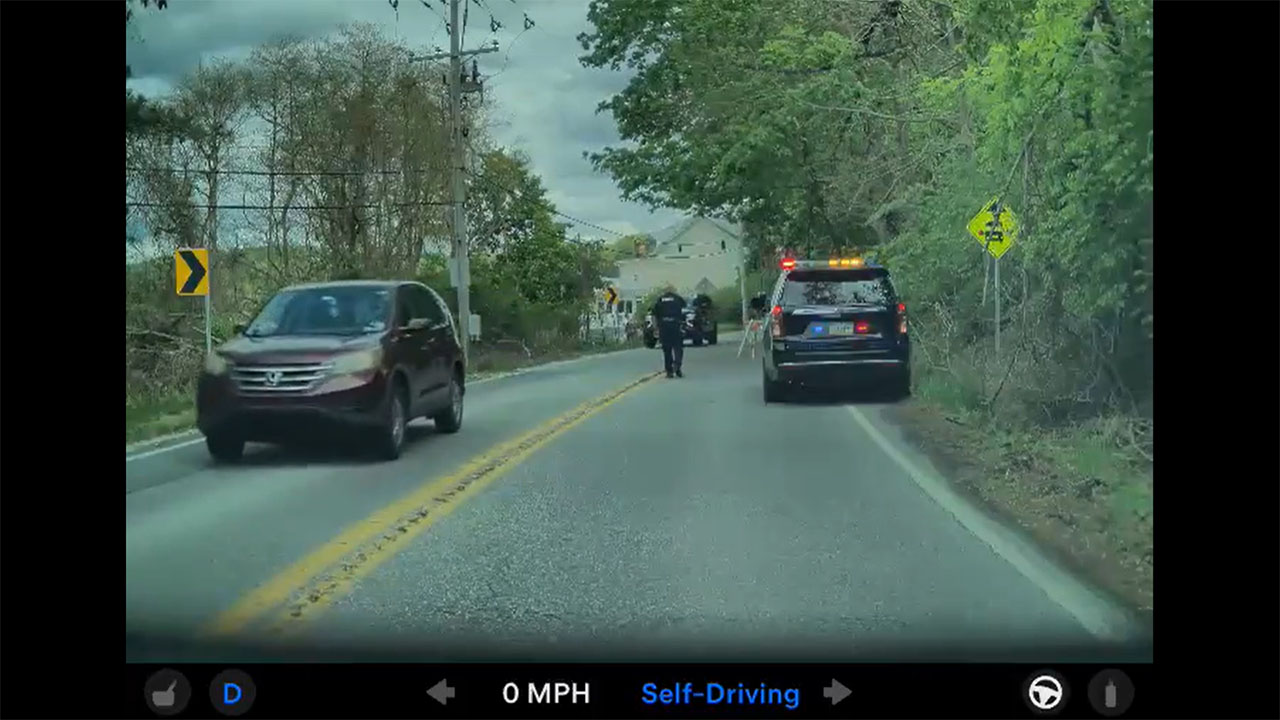
Tesla’s Full Self-Driving (FSD) system just crossed a new frontier in human-machine interaction. A newly surfaced video shows a Tesla running FSD v14.2.2.5 successfully interpreting and obeying the hand gestures of a police officer directing traffic. This isn't just a party trick; it represents a profound leap in how an electric vehicle perceives and reacts to non-verbal human commands in complex, real-world scenarios. The moment the vehicle recognized a stopped police cruiser ahead and then processed the officer’s manual signals to proceed safely marks a significant milestone for Tesla’s AI.
The Gesture Recognition Breakthrough
In the footage, the Tesla approaches a situation where standard traffic flow is interrupted by a police presence. Instead of simply stopping or getting confused by the ambiguous environment, the FSD v14 software analyzes the officer’s specific hand movements. The vehicle not only identifies the human figure but also deciphers the directional intent behind the gestures. This moves beyond simple obstacle detection; it is contextual understanding. The car effectively “reads” the officer’s instruction to proceed, integrating that command with its own path planning to navigate the scene smoothly without abrupt or unsafe maneuvers.
Why This Matters for AI and Autonomy
This capability addresses one of the most challenging edge cases for autonomous driving: non-standard traffic control. Traffic lights are binary; hand signals are nuanced. For years, the industry struggled with how to handle situations where a human override is required, such as accident scenes or construction zones. By demonstrating that Tesla’s neural network can interpret a police officer’s body language, the company shows it is building a system that can operate within the flexible, human-centric framework of real-world driving. This reduces the likelihood of the vehicle becoming a stationary hazard when human authority intervenes.
Implications for Tesla Owners and Investors
For current Tesla owners, this update signals that their vehicles are becoming increasingly capable of handling unpredictable urban environments. It directly enhances safety and convenience, reducing the need for driver takeover in police-directed traffic. For investors, this is a tangible validation of Tesla’s end-to-end AI approach. While competitors rely on high-definition maps and rigid rule-based systems, Tesla’s ability to adapt to dynamic human cues suggests a more scalable and robust path to true autonomy. As regulatory approval for unsupervised FSD looms, this feature could be a critical differentiator in proving the system’s safety and competence in the eyes of lawmakers.