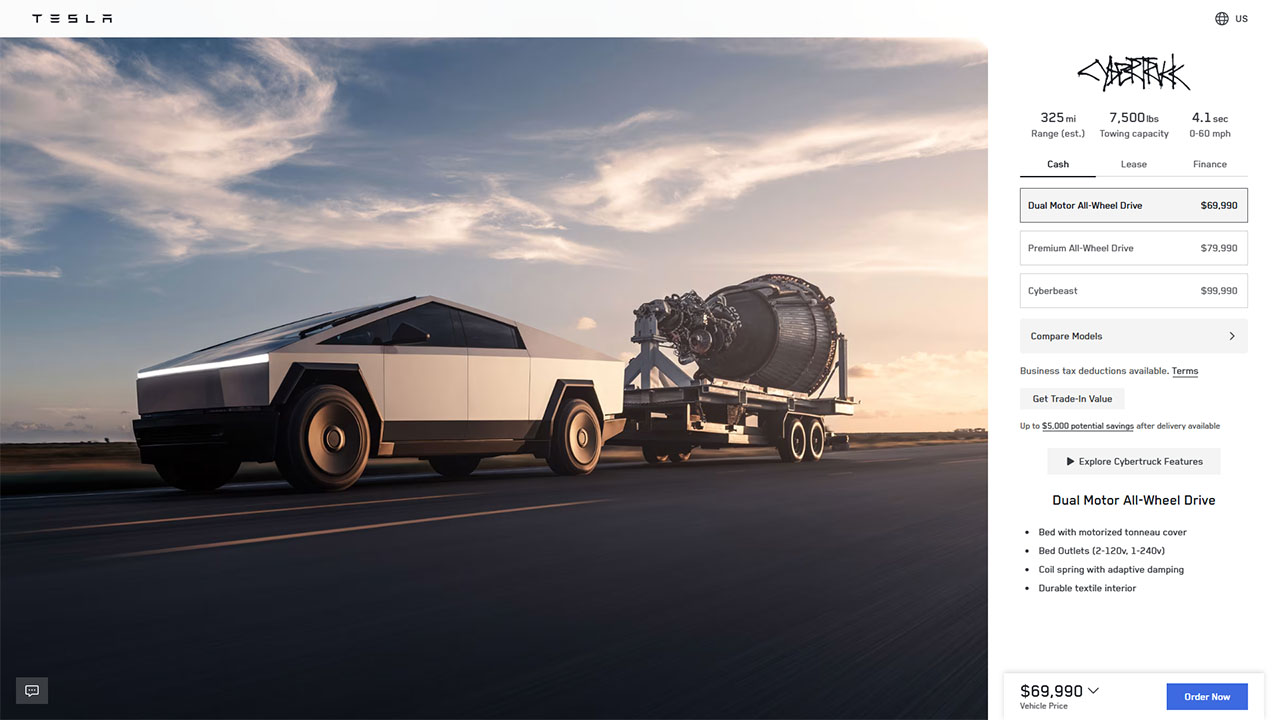
Tesla's Cybertruck, a vehicle that has thrived on defying convention, is now facing a more traditional automotive industry challenge: customer backlash over pricing. In a move that has ignited frustration across forums and social media, Tesla has increased the price of the newly introduced Cybertruck All-Wheel Drive (AWD) variant by $10,000, pushing its starting cost to $79,990. This abrupt adjustment, coming just weeks after the model's configurator went live, underscores the volatile nature of Tesla's pricing strategy and has left early reservation holders feeling penalized for their swift commitment.
A Surge in Demand Triggers a Price Hike
The catalyst for the increase appears to be the model's immediate popularity. Following the opening of orders for the base AWD variant, Tesla was inundated with reservations, an influx so significant it reportedly pushed estimated delivery timelines into 2025. CEO Elon Musk had previously hinted that initial pricing was likely to be temporary, framing it as an incentive for early adopters. This practice, while not uncommon for Tesla, creates a high-stakes game for customers who must decide whether to lock in a configuration immediately or risk a potential price increase by waiting. For many, the speed of this particular change felt like a bait-and-switch, transforming excitement into financial recalculation overnight.
Broader Implications for the EV Market and Tesla's Strategy
This pricing maneuver extends beyond Cybertruck forums and speaks to Tesla's evolving position in the electric vehicle landscape. As competition intensifies, Tesla's traditional price-cutting strategy has given way to more dynamic and model-specific adjustments. The Cybertruck, with its cult-like following and production constraints, operates in a unique sphere where demand appears inelastic. The price hike tests the limits of that loyalty and serves as a real-time experiment in pricing power. It also starkly highlights the growing cost gap between the promised "sub-$40,000" truck unveiled in 2019 and the current reality, a point of contention that continues to shadow the vehicle's rollout.
For Tesla investors, the situation is a double-edged sword. On one hand, the ability to raise prices by a substantial margin without canceling a flood of orders demonstrates remarkable pricing authority and should positively impact near-term margins on a vehicle that is likely still production-constrained. On the other hand, it risks eroding the brand's goodwill with its most ardent supporters, the core customer base that fuels the company's marketing through word-of-mouth. The long-term cost of perceived opportunism may outweigh the short-term revenue gain if it dampens the evangelical enthusiasm that has been a cornerstone of Tesla's success.
For current Cybertruck reservation holders, the decision is now fraught with financial consequence. Those who hesitated may face a steeper-than-expected entry price, while those who configured early are breathing a sigh of relief. For the broader community of EV enthusiasts and potential buyers, this episode is a stark reminder that in Tesla's world, pricing is as dynamic and unpredictable as the vehicles themselves. It reinforces the need to act decisively when a desired configuration becomes available, but also injects a note of caution into the reservation process, where a promised price is not a guarantee but a starting point for negotiation—with the manufacturer holding all the cards.