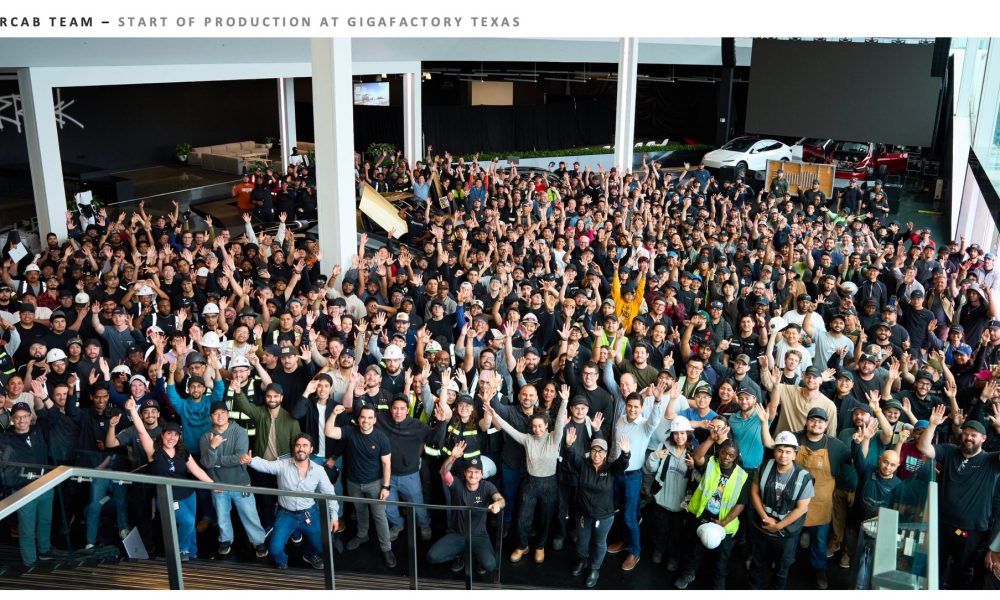
Tesla has officially crossed a pivotal threshold in its autonomous driving ambitions. In a landmark announcement today, the company confirmed that the Cybercab, a radical two-passenger electric vehicle designed without a steering wheel or pedals, has entered production at its Giga Texas facility outside of Austin. This moment marks the first time a major automaker has begun manufacturing a purpose-built, fully autonomous vehicle for mass deployment, signaling a seismic shift in the transportation landscape.
A Purpose-Built Robotaxi
The Cybercab is not a modified consumer car. It is a sleek, two-door coupe engineered from the ground up as an electric self-driving vehicle. Its most striking feature is the complete absence of traditional driver controls. There is no steering wheel, no brake pedal, and no accelerator. The vehicle relies entirely on Tesla’s advanced Full Self-Driving (FSD) hardware and software suite to navigate. The design prioritizes passenger comfort and efficiency over driver engagement, with a minimalist interior focused on a single, large central display. This vehicle is the cornerstone of Tesla’s ambitious plan to launch a network of autonomous ride-hailing services.
Production Reality and Strategic Implications
This confirmation moves the Cybercab from concept to tangible product. Production at Giga Texas, Tesla’s sprawling manufacturing hub, is a clear signal of the company’s commitment to scaling this vehicle. While initial volumes are expected to be modest, the fact that manufacturing has begun allows Tesla to begin real-world validation of the vehicle’s systems at scale. This is a stark contrast to competitors who remain in the testing phase with heavily modified existing models. The Cybercab is a clean-sheet design, optimized for the economics of a robotaxi fleet, which could give Tesla a significant cost and efficiency advantage in the long run.
This move also reshapes the competitive landscape. By producing a vehicle with no manual override, Tesla is placing a massive bet on the reliability and safety of its autonomous system. The company is effectively bypassing the traditional driver-assistance evolution and jumping straight to full autonomy. For investors, this represents a high-risk, high-reward strategy. Success would unlock a multi-trillion-dollar market in mobility-as-a-service. Failure, however, could be catastrophic, both financially and reputationally.
What This Means for Tesla Owners and Investors
For current Tesla owners, this development underscores the long-term value of the company’s FSD technology. The same underlying software stack that powers the Cybercab will continue to improve for consumer vehicles. However, the Cybercab’s dedicated design suggests that Tesla sees a future where the majority of miles driven are not in personally owned cars, but in autonomous fleets. For investors, the production start is a crucial de-risking event. It moves the narrative from "if" to "when." The key metrics to watch now are production ramp rates, regulatory approvals for commercial driverless operations, and the unit economics of each Cybercab. This is the beginning of the next chapter for Tesla, one that could redefine the automotive industry as we know it.