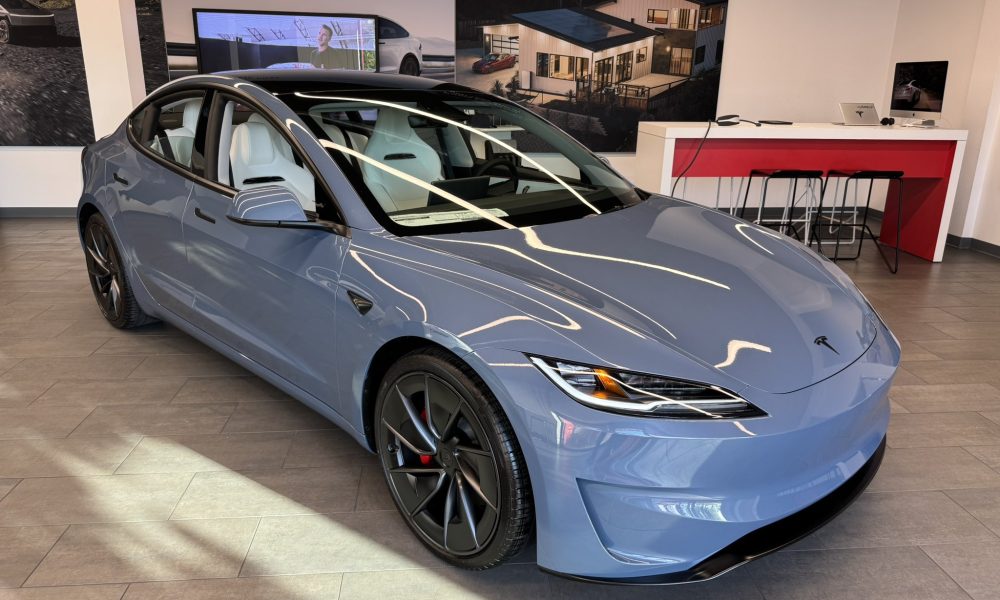
Tesla has quietly revised a critical performance metric for its recently refreshed Model 3 lineup in Canada, adjusting the listed 0–100 km/h acceleration time for the Premium Rear-Wheel Drive (RWD) variant just days after orders first went live. The change, which surfaced on the company’s Canadian configurator, signals that Tesla is fine-tuning its product specifications in real time—a move that could impact buyer expectations and the vehicle’s competitive positioning in the country’s growing EV market.
What Changed and Why It Matters
When the updated Model 3 lineup initially appeared on Tesla’s Canadian website, the Premium RWD was listed with a 0–100 km/h sprint time of 6.1 seconds. That figure has now been updated to 6.3 seconds, a modest but notable downgrade of two-tenths of a second. While the difference may seem marginal on paper, the revision is significant for a brand that prides itself on performance transparency and consistency. The adjustment likely stems from real-world testing data, regulatory recalculations, or battery management optimizations that slightly temper the initial launch surge. For a vehicle that competes directly with the likes of the Hyundai Ioniq 6 and BMW i4, even small spec changes can influence buyer decisions in a segment where every tenth of a second counts.
Context Within the Refreshed Model 3 Lineup
The Premium RWD sits as the entry-level offering in Tesla’s updated Model 3 family, positioned below the Long Range AWD and Performance trims. The revised acceleration time does not affect the dual-motor variants, which retain their published figures of 4.4 seconds (Long Range) and 3.1 seconds (Performance) for the same benchmark. This targeted update suggests that Tesla is specifically calibrating the base RWD model for efficiency and range optimization rather than outright speed—a logical trade-off given its role as the most affordable option. Canadian buyers, who already face higher import duties and a $5,000 federal iZEV rebate eligibility cap, will now have to weigh the slightly slower sprint against the car’s improved range and refreshed interior features.
Implications for Tesla Owners and Investors
For existing reservation holders and prospective buyers, the change is a reminder that Tesla’s online configurator remains a living document. Those who locked in orders based on the original 6.1-second spec may feel a twinge of disappointment, though the real-world difference is unlikely to be perceptible in daily driving. More importantly, the revision underscores Tesla’s willingness to prioritize consistency over marketing hype—a signal that the company is maturing its production processes. For investors, the adjustment is a minor blip; the Model 3 remains Canada’s best-selling EV, and the Premium RWD’s value proposition hinges on its $53,990 CAD starting price and long-range capability, not just its launch speed. As Tesla continues to refine its vehicle specs post-launch, stakeholders should watch for further tweaks to battery chemistry or software that could enhance efficiency without sacrificing performance.