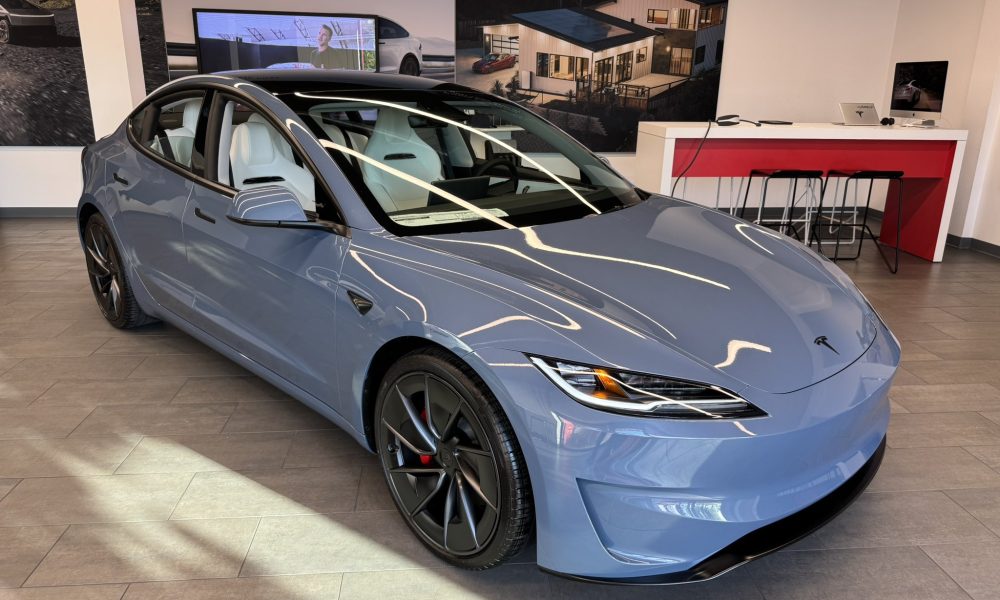
In a move that underscores its philosophy of continuous, often unannounced improvement, Tesla has initiated a subtle but significant hardware change within the newly refreshed Model 3. Buried within recent service documentation, the shift points to a future where the electric sedan could do more than just drive—it could power your home, tools, or campsite. This quiet upgrade to what is being called the PCS2Lite power conversion system is a strong technical indicator that Tesla is laying the groundwork for long-requested vehicle-to-load (V2L) functionality.
Decoding the PCS2Lite: More Than a Silent Swap
The Power Conversion System (PCS) is the unsung hero of an EV, managing the critical flow of electricity between the battery pack, drive units, and charging ports. The new PCS2Lite unit, now appearing in Model 3 vehicles, represents an evolution from the previous PCS2 hardware. While outwardly invisible to owners, the change is material. Service documents confirm the new part number and a revised design, suggesting Tesla is optimizing the system's capabilities. Crucially, for V2L to work, the PCS must be capable of bidirectional power flow—not just taking AC current from a charger and converting it to DC for the battery, but also inverting DC battery power back into usable AC current to send outwards. The PCS2Lite appears to be engineered for precisely this bidirectional potential.
The V2L Promise: Unlocking the Model 3's Mobile Power Plant
Vehicle-to-load technology transforms an EV from a consumer of energy into a mobile energy storage unit. If enabled via a future software update, a Model 3 with the new hardware could power essential home appliances during an outage, provide electricity for job sites, or become the ultimate power source for weekend camping. This aligns with Tesla's broader energy ecosystem vision, which includes the Powerwall and Megapack. While competitors like the Ford F-150 Lightning and Hyundai Ioniq 5 already offer robust V2L, Tesla has, until now, limited its vehicles to a modest "vehicle-to-vehicle" charging feature. The PCS2Lite hardware shift is the clearest signal yet that Tesla is preparing to close this feature gap and turn its fleet into a distributed network of backup power sources.
However, a critical caveat remains: hardware capability does not guarantee software activation. Tesla is known for installing forward-looking hardware—like the unused wiring harness for a front bumper camera on Cybertruck—that may or may not be activated later. The company's decision will likely hinge on rigorous testing for safety, grid impact, and battery longevity. Furthermore, enabling convenient V2L would require a compatible external power outlet adapter, which Tesla does not currently sell for the Model 3 or Model Y. The hardware foundation is now being poured, but the final build-out depends on Tesla's strategic priorities.
Implications for Owners and the EV Landscape
For current and prospective Model 3 owners, this under-the-radar update underscores the value of buying a Tesla during a production refresh. Vehicles built after this hardware change are future-proofed for a potentially major value-added feature. For the wider EV market, Tesla's move signals an industry-wide march toward bidirectional charging as a standard expectation. It puts pressure on other automakers to match not just driving range, but also the vehicle's utility as a versatile energy asset. Investors should view this as a incremental step in strengthening Tesla's product moat and its integration between automotive and energy divisions, potentially opening up new revenue streams from energy services and accessories.
The quiet arrival of the PCS2Lite is a classic Tesla maneuver: innovate first, announce later. While owners await an official word from Elon Musk, the evidence in the service manual is compelling. The upgraded Model 3 now has the physical heart to become a power outlet on wheels—it's just waiting for the digital command to start beating in reverse.