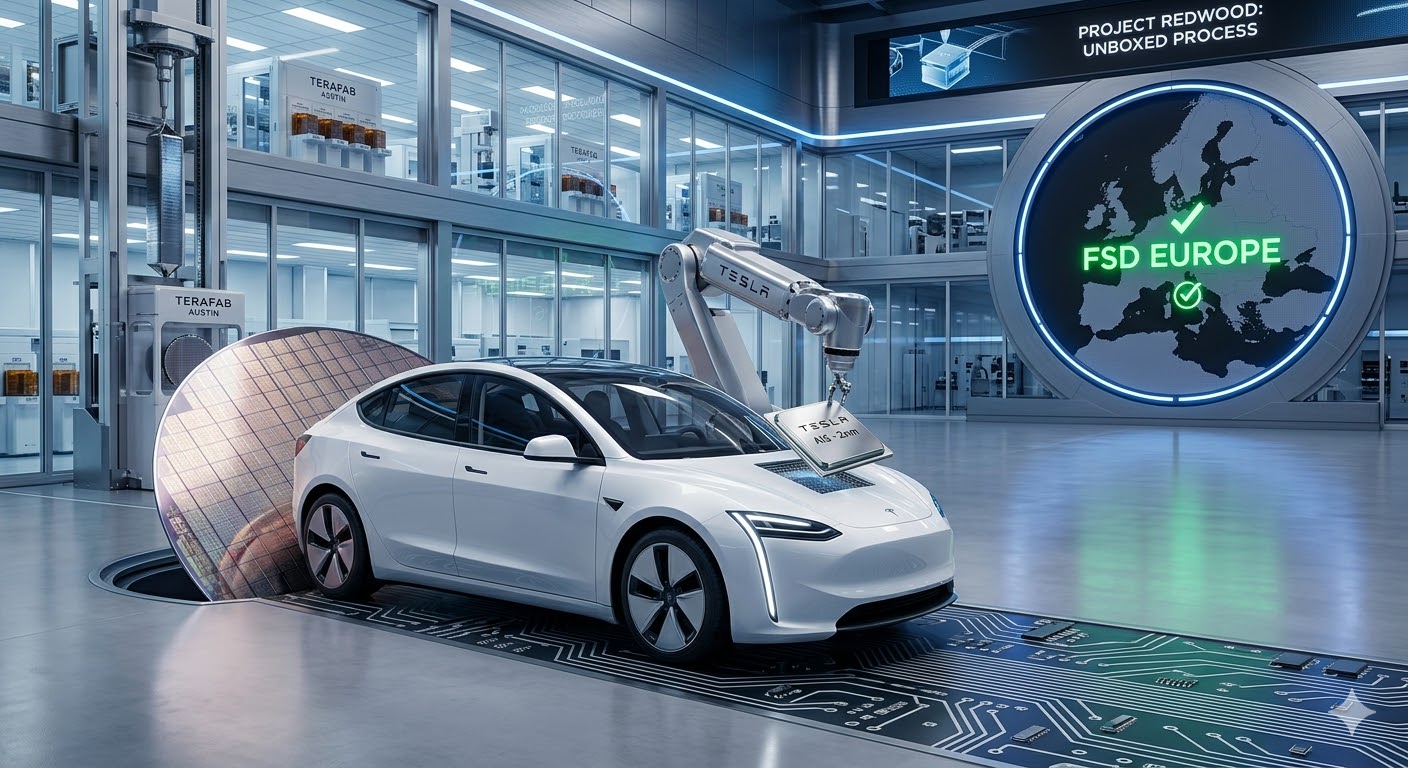
The race for the affordable electric vehicle has just entered a new, decisive phase. Less than two weeks after initial reports on Tesla's codenamed Project Redwood, two seismic announcements have fundamentally reshaped the narrative around the anticipated $30,000 model. This is no longer just about a cheaper car; it is about the unveiling of an entirely new manufacturing paradigm designed to make that car not only possible but profoundly profitable.
Terafab: The Manufacturing Revolution Behind the Price Tag
Elon Musk's revelation of the "Terafab" project is the cornerstone of this shift. While details remain guarded, industry analysis suggests Terafab represents a radical, next-generation assembly system. Moving beyond the unibody "gigacasting" innovations of the past, Terafab is believed to integrate a revolutionary approach to vehicle modularity and assembly speed. The name itself—implying a terawatt scale of production—hints at ambitions far exceeding current Gigafactory output. This isn't merely an incremental improvement; it's the foundational technology intended to slash production costs to the levels required for a high-volume, $25,000-$30,000 Tesla while maintaining robust margins.
Strategic Independence and the European Catalyst
The second pivotal development is the imminent regulatory approval for Full Self-Driving (FSD) in Europe. This convergence is critical. Project Redwood, built on the Terafab system, is poised to be the first Tesla designed from the ground up to leverage a truly scalable, software-defined autonomy platform from day one. Gaining access to the massive European market with FSD capability transforms the compact car's value proposition. It ceases to be a simple entry-level EV and becomes a high-margin platform for recurring software revenue in a new, volume-driven segment. This dual advantage—revolutionary manufacturing and immediate software monetization—grants Tesla unprecedented strategic independence from traditional automotive cost curves.
For Tesla, the implications are monumental. The company is effectively de-risking its most ambitious vehicle project by simultaneously solving its two greatest challenges: unit economics and long-term profitability per vehicle. Terafab addresses the former, while a global FSD rollout, starting with Europe, locks in the latter. This paves the way for Redwood to achieve scale at a pace and efficiency that legacy automakers, still grappling with the transition to dedicated EV platforms, would struggle to match.
For Tesla owners and investors, these developments signal a decisive move into the heart of the global automotive market. A profitable, high-volume compact Tesla disrupts the entire industry's competitive landscape, potentially capturing the segment that has historically driven volume for giants like Toyota and Volkswagen. For investors, it validates the long-term thesis of Tesla as a technology and manufacturing disruptor, not just an EV brand. For future owners, it promises access to Tesla's core technology—safety, performance, and advanced autonomy—at a previously unthinkable price point, accelerating the world's transition to sustainable energy not from the top down, but from the ground up.

