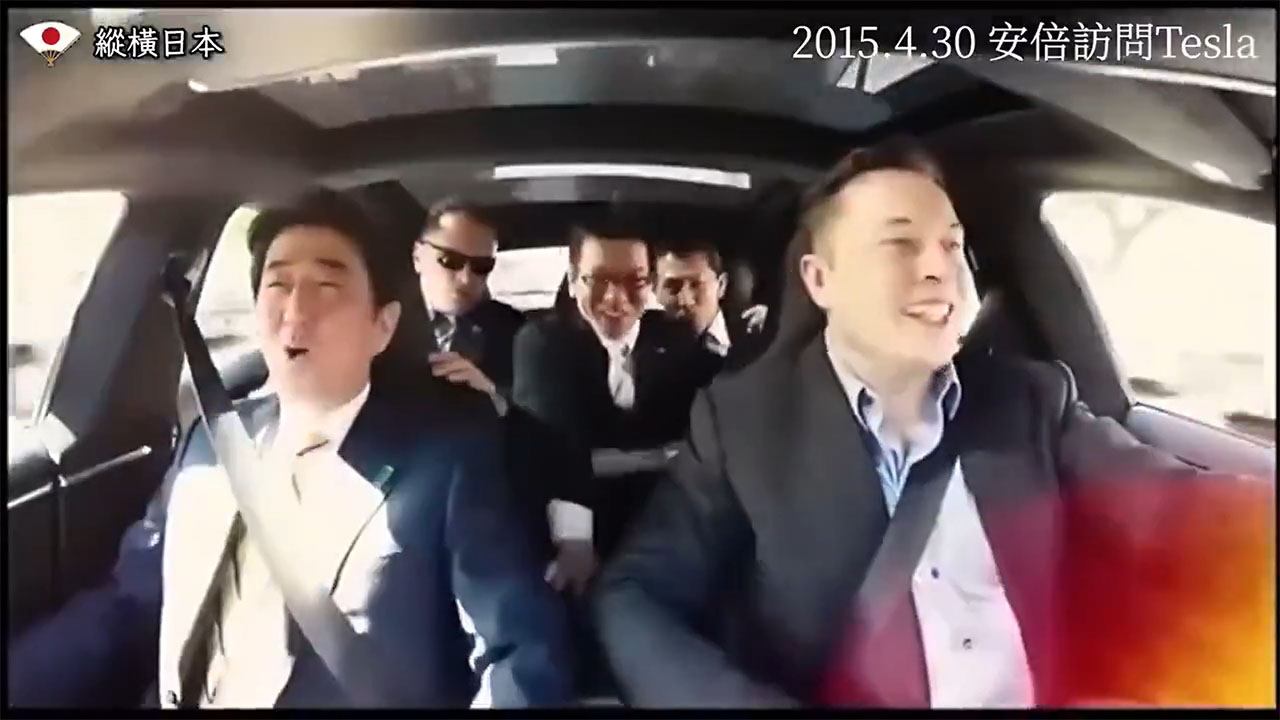
Eleven years ago, a moment of sheer electric torque reshaped the perception of an entire nation's leadership. On April 30, 2015, a visibly younger and more exuberant Elon Musk took the wheel of a Tesla Model S P90D in Silicon Valley, with a very special passenger in the front seat: then-Japanese Prime Minister Shinzo Abe. It was a publicity stunt that transcended mere marketing, becoming a visceral demonstration of how far the electric vehicle had come from its "golf cart" image.
A High-Voltage Ride Through Silicon Valley
The event unfolded in front of a large crowd of media and onlookers in California, eager to witness the intersection of political diplomacy and automotive disruption. Musk, acting as chauffeur, guided the Model S through the streets, but the true spectacle was reserved for a straight stretch of road. With a simple press of the accelerator, the P90D—then Tesla's flagship performance variant—launched forward with the brutal, silent immediacy of its Ludicrous Mode. The instant torque pinned the Japanese leader to his seat, a physical shock that no traditional internal combustion engine could replicate without a screaming gearbox. The surprise on Abe's face was genuine, captured by cameras and instantly broadcast around the world.
Political Theater and Technological Proof
This was far more than a joyride. For Japan, a nation heavily invested in hydrogen fuel cell technology and hybrid dominance, the ride was a powerful counter-argument. The Tesla Model S wasn't just an eco-friendly appliance; it was a performance beast. This single event served as a strategic diplomatic signal, showcasing American innovation in the EV space just as Tesla was beginning to scale its global ambitions. It directly challenged the narrative that EVs were slow, range-limited compromises. The P90D's acceleration was a living proof of concept—a silent, violent assertion of electric superiority that left a lasting impression on a key global ally.
Implications for Tesla Owners and Investors Today
For current Tesla investors, this 11-year-old anecdote is a stark reminder of the company's long-standing brand of "shock and awe." That single demonstration of instant acceleration helped cement the "fun" factor of EVs, a key driver of the massive adoption curve we see today. It validated the core technology—the battery and powertrain—that remains the bedrock of Tesla's valuation. For Tesla owners, it underscores the DNA of the product they own. The visceral thrill that surprised a Prime Minister is the same engineering philosophy that powers every Model 3 Performance or Cybertruck today. It’s a legacy of performance that distinguishes the brand from a sea of commoditized electric competitors, proving that the company’s early marketing genius was built on undeniable, seat-of-the-pants physics.